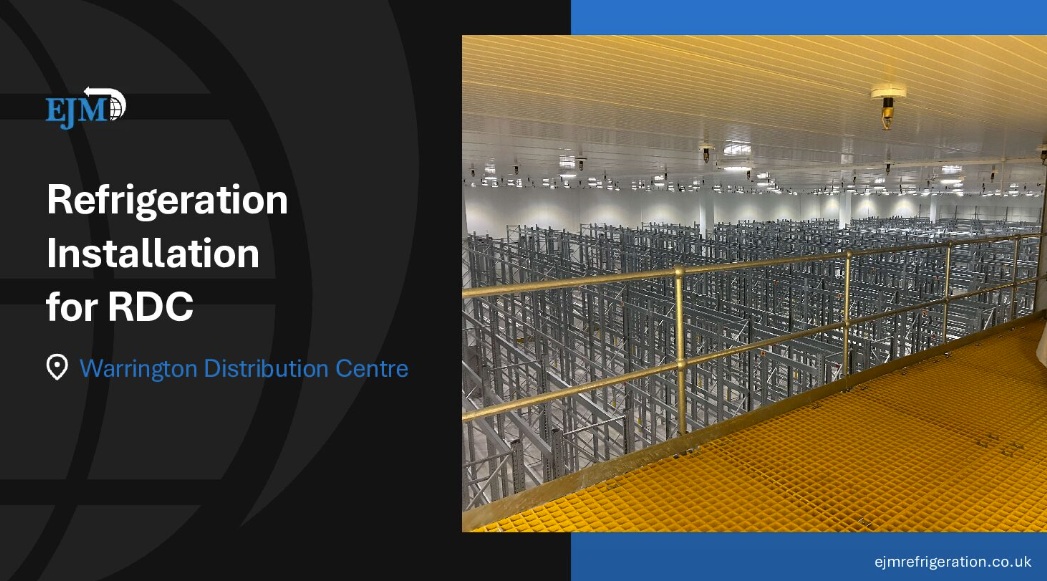
A food factory or cold store that is about to add a chamber, replace tired central plant or freeze a new product line does not need a brochure. It needs a specification that matches how the building actually runs. EJM has carried out industrial refrigeration work since 1980, as an independent contractor, on duties that include low-temperature and chill distribution stores, in-line and air-blast freezing, plate freezing, dairy water chilling, abattoirs, ice production and process cooling.
November is an awkward month to discover that last year’s “we will specify it in the new year” project has nowhere to land in the diary. If you are still shaping the brief, answer the questions below before anyone prices a compressor pack.
Start with the process, not the plant
Write down the product, the in and out temperatures, the hourly throughput, and how the room is trafficked. A chill distribution store with many loading doors is a different machine from a low-temperature store with a few well-managed openings. An in-line freezer that must keep time with a production belt is a different machine from a holding freezer that can recover overnight.
Abattoirs, dairies and prepared-food plants add hygiene, washdown and odour. Chemical process cooling and ice production add different fluids and risk. If the brief says only “we need more cold”, the first survey will be spent extracting those facts anyway. Put them on paper first, then write down what must not stop. Some sites can isolate a chamber; others cannot lose a glycol loop that feeds several rooms. EJM’s industrial page notes that upgrades are often done with minimum disturbance to production — only possible if the specification admits which parts of the factory are sacred.
Direct ammonia, secondary glycol and mixed systems
Ammonia has been a natural refrigerant for EJM from the start. It is zero rated for ozone depletion potential and global warming potential, which is why it remains a serious option for large industrial plant as fluorinated-gas limits tighten. Typical arrangements on our industrial list include pumped ammonia with hot gas defrost, and low-pressure receiver systems with reverse cycle defrost.
Not every zone needs ammonia in the occupied space. Multi-zone projects can use pumped ammonia for primary freezing and chilling, with secondary glycol to preparation and packing. That split is an engineering choice about charge location, temperature and maintenance — not a moral ranking of refrigerants. CO2 transcritical systems and propane also sit in EJM’s natural-refrigerant work; the natural refrigerants page sets out where each tends to fit. Name the duty before the refrigerant, and ask for options rather than a single branded solution.
We can advise on the F-Gas context as it affects existing plant and new choices. That is not a legal opinion and not a promise of a particular compliance result. Your own duties remain yours.
Blast freezing, plate freezing and distribution stores
Air-blast and in-line freezing live or die on air speed, product configuration and defrost. If the product coming off the line is wet, irregular or packed in a new carton, last year’s freezer may not do this year’s job even if the kW look similar on paper. Horizontal and vertical plate freezers have their own constraints: cycle time, block size, and how the rest of the factory feeds them.
Distribution stores are about doors as much as evaporators. Low-temperature and chill stores only work as a system with the dock, marshalling and traffic plan. Specify those, or you will buy a plant that spends its life recovering from open doors. Dairy water chilling, ice plants and chemical process cooling belong in the same industrial family but need their own fluid, material and control choices — do not copy a cold-store specification across because it is “also cooling”.
Designing for live sites and later extension
Very few UK food sites are empty sheds. The specification should say how the new plant will be installed while the old plant still runs: phased pipework, weekend changeovers, temporary cooling, or a new plant room built off to one side. Pre-insulated pipework systems, which EJM uses on large industrial jobs for a robust finish, need space and access that a last-minute route through live production may not have.
Think one expansion ahead. If a second chamber is likely, leave hydraulic, electrical and control capacity that does not require tearing the first installation apart. Independent equipment selection helps: you are not forced to expand only within one manufacturer’s frame size. Controls should be specified for the people who will stand in front of them at 5am. If the factory already has a preferred monitoring approach, say so; if not, ask what alarms will look like in six months, not on handover day.
Independence from a single manufacturer
EJM is not tied to one compressor or evaporator brand. The industrial service page states that directly: as an independent company we select and supply equipment that suits the need. That matters when a site already has a mix of machines, when spares strategy is a real constraint, or when a particular duty is better served by one maker’s compressor and another’s evaporator.
Independence is not a reason to mix plant for the sake of it. It is a reason to write a specification that names duties, temperatures, defrost method, standby and how the plant will be maintained — then choose equipment against that list. If a tender only names a brand, you have specified a catalogue, not a refrigeration system. Maintenance belongs in the same document: a plant that cannot be isolated and overhauled will cost more than a slightly more expensive layout that can. EJM’s service team works on plant it has built and on plant installed by others; assume someone will still be in that plant room in ten years.
Request a site survey from EJM
A free initial consultation and site survey is the usual starting point, as described in our FAQ. Bring production volumes if you have them, a plan of the building, and an honest note on which shutdowns are possible. We can then talk about industrial refrigeration options, including ammonia and secondary systems, without asking you to commit to a design in the first meeting.
Surveys can be arranged from Durham, Derby, Ashford or Glasgow. Use the contact page and say whether the project is a new store, an extension, a freezer or process cooling. Distribution centres should also read the cold storage and distribution page; food plants the food manufacturing page.
To discuss a survey, a maintenance visit or a new installation, contact EJM Refrigeration on 01429 836 161 or email contact@ejmrefrigeration.co.uk.