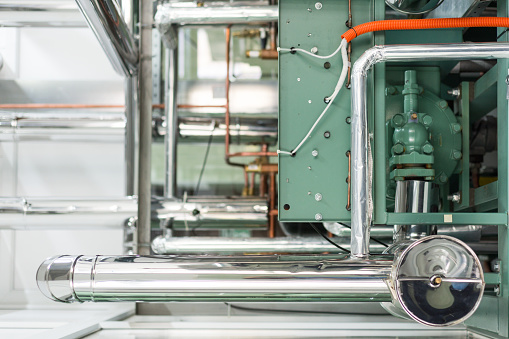
EJM is best known for food factories and distribution centres. The commercial refrigeration page is explicit, though, that bespoke systems are also supplied for science laboratories, advanced composites, hospitals, pharmacies and mortuaries. Those rooms are not walk-in chillers with a different paint colour. They are occupied, often regulated, and intolerant of draughts, noise and surprise downtime.
If you are specifying or replacing plant in one of those settings this winter, ask the questions below before anyone talks about a catalogue model. EJM can survey from Durham, Derby, Ashford or Glasgow depending on where the building is.
Not every cold space is a food store
A food cold room is usually judged on product temperature, door durability and cleanability. A mortuary cold room is judged on those plus dignity, access for trolleys, and the ability to hold temperature if a door is open longer than a warehouse picker would allow. A pharmacy fridge room is judged on recorded temperature, not on whether it “feels cold”. A laboratory may care as much about humidity and air movement as about the set-point.
Advanced composites and other process rooms can be even more particular: a few degrees either way changes the material, not only the comfort of the people in the space. Close-control air conditioning and refrigeration overlap here. The right contractor is one who will ask what the space is for, not one who starts with a standard cold-room drawing.
Because EJM is independent, the conversation can include packaged equipment, split systems, secondary glycol or a small dedicated plant room. There is no requirement to force a food-industry ammonia solution into a hospital basement, or a light commercial unit onto a duty it will not survive.
Temperature, humidity and air movement
Close control means the room stays within a band, including when doors open and when outside conditions change. In November that outside condition is cold, wet air. A system that only ever ran in summer may now short-cycle, ice on the coil, or blow a noticeable draught across a bench or a trolley bay.
Air distribution inside the room deserves as much attention as the compressor outside it. The commercial refrigeration service page lists this directly: consider air distribution in temperature-controlled areas so that noise and draughts are minimised. In a laboratory that is the difference between a usable bench and a workspace people avoid. In a mortuary it is the difference between a quiet, even room and one with a noisy evaporator over the only working position.
Humidity control sits with air conditioning as well as refrigeration. Clean rooms and close-control systems are listed on EJM’s ventilation page for a reason. If the specification only names a temperature, ask what relative humidity the process or the building actually needs, and how moisture from doors, showers or nearby kitchens will be handled in winter.
Stand-by plant and access for maintenance
Food sites often accept a short, planned downtime. Hospitals and mortuaries usually cannot. Stand-by capability of equipment is one of the design points EJM lists for commercial refrigeration, alongside life-cycle cost and reliability using proven manufacturers. That does not mean every small room needs a duplicate system. It does mean you should decide, in writing, what happens if the only evaporator fan fails on a Sunday.
Access is the practical half of that decision. Plant hidden behind a locked riser with no isolation, no drain and no space to withdraw a compressor is cheap on day one and expensive on day two. In occupied buildings, maintenance windows are also social: noise, hot works and refrigerant handling have to be planned around patients, staff and neighbours.
Remote monitoring and alarm routing matter more here than on a staffed night shift in a factory. Someone has to be told, and they have to know whether they are looking at a nuisance alarm or a room that is warming. Do not leave that to a sticker on the plant-room door that nobody has updated.
Refrigerant and secondary circuit choices
Commercial projects at EJM are discussed in detail with the client, including the type of refrigerant, whether a secondary glycol system is a better fit than solely direct expansion, and the wider F-Gas context. That is advice and engineering judgement, not a legal determination and not a guarantee of a particular compliance outcome. Operators remain responsible for the duties that apply to their site.
Glycol secondary circuits can be attractive in occupied buildings because they can reduce the amount of refrigerant in occupied spaces and make maintenance more local. They also need their own care: concentration, inhibitors, pumps and heat exchangers. Direct expansion can be simpler, but a leak is then in the room. Neither answer is universal.
Natural refrigerants — ammonia, CO2 and propane — are central to EJM’s industrial work and are explained on the natural refrigerants page. For a small mortuary or laboratory they may or may not be the right tool. The honest specification starts with charge size, location, competence of the maintenance team and what the room must do, not with a slogan.
Working in occupied, regulated buildings
Installation in a live hospital, laboratory or public building is a logistics problem as much as a refrigeration problem. Deliveries, parking, infection-control rules, out-of-hours working and the need to keep an old system running until the new one is commissioned all have to be in the programme. EJM’s industrial side already works around live production; the same discipline applies here, with different neighbours.
Documentation should be usable. Asset lists, set-points, alarm tests and service history should be something the facilities team can find, not a folder that left with the last contractor. Where EJM maintains plant, Joblogic is used so customers can see job history and plant records rather than relying on paper alone.
If the same campus also has food-service cold rooms or mortuary overflow at peak winter demand, say so at survey. Shared plant rooms and alarms are where these buildings usually come unstuck.
Discuss a close-control project with EJM
Bring a plan of the room, the required temperature band if you have one, and a note on how the space is used at night and at weekends. We can then talk about commercial refrigeration options, close-control air conditioning, or a mix, without forcing the project into a food-store template.
Use the contact page and choose a new installation or a free site survey. Name the town so the enquiry can go to Durham, Derby, Kent or Glasgow.
To discuss a survey, a maintenance visit or a new installation, contact EJM Refrigeration on 01429 836 161 or email contact@ejmrefrigeration.co.uk.