From Hartlepool fish merchants to farm shops, butchers, bakers and cash-and-carry stores around Durham and Teesside, a walk-in cold room is often the piece of plant the whole week hangs on. If it drifts a few degrees, product is at risk. If it stops, trading stops with it.
Christmas trading makes that dependence obvious. Door openings multiply, deliveries bunch into fewer windows, and outdoor condensers that coped in October start to work harder in wet, cold air. The useful moment to act is now — while there is still time to inspect, order parts and book engineers — not in the week before Christmas Eve.
EJM Refrigeration designs, installs and maintains commercial refrigeration for food businesses and other temperature-critical sites. This note is a practical briefing for operators who want their walk-in rooms to get through December without drama.
Why mid-November is the right moment
Ambient temperatures have fallen, so the plant is no longer fighting a heatwave. That can hide problems. A condenser that was dirty in August may still hold temperature on a quiet November Tuesday. The same condenser, with the same fouling, may not hold when staff are in and out of the room every few minutes with festive stock.
Lead times are the other reason to move now. Door furniture, fan motors, controllers and refrigerant recovery all take longer once every contractor’s diary fills. A visit this week can turn a known weak point into a planned repair. Leave it until the first alarm in December and you are competing with everyone else’s emergency.
Sites around County Durham, Teesside and North Yorkshire that we already maintain tend to use this window for a short, focused cold-room pass rather than a full annual service. The aim is simple: confirm the room will still pull down after a busy door day, and that alarms will actually reach someone if they do not.
What usually fails first on a busy cold room
Walk-in rooms are mechanically simple compared with a distribution-centre ammonia plant, but the failure modes are familiar.
- Door seals, hinges, closers and heaters that have been hit by trolleys
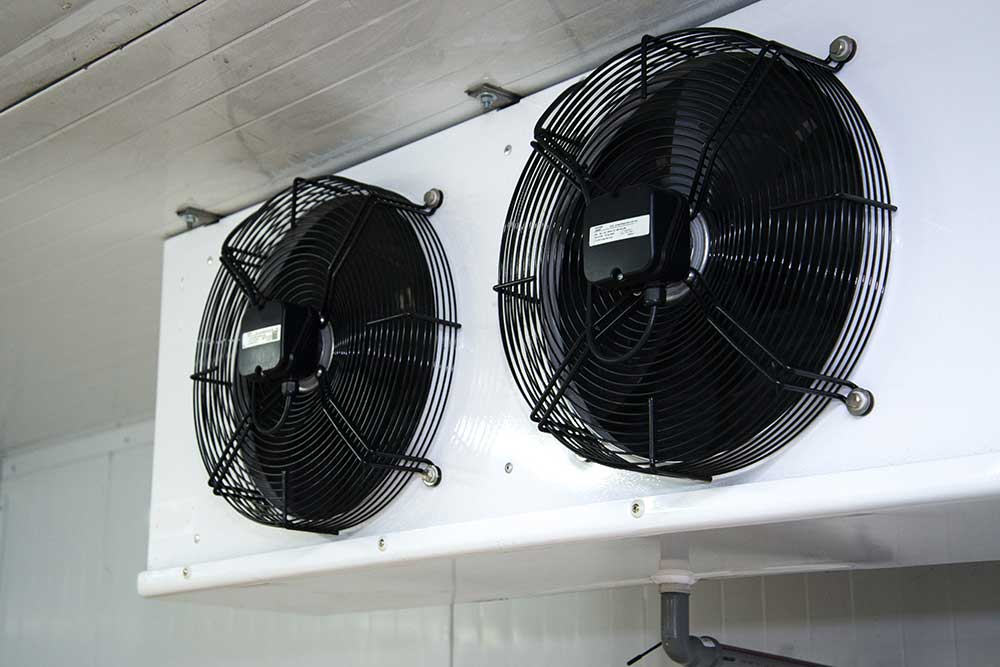
- Evaporator coils furred with dust, cardboard fibre or ice
- Blocked or frozen condensate drains
- Outdoor condensers clogged with leaves, packaging film or salt-laden dirt
- Controllers with tired batteries, wrong set-points or silenced alarms
None of these requires a specialist lecture. They do require someone to look, rather than assuming last summer’s service is still good enough. A room that “feels cold” when you walk in at 8am can still be struggling by mid-afternoon once product, people and door traffic have done their work.
Lighting heat, poorly fitting strip curtains and stock stored hard against the evaporator also steal capacity. Before you blame the compressor, look at how the room is being used.
A practical pre-Christmas inspection
A useful November visit is short and specific. It is not a substitute for a planned maintenance programme, but it catches the faults that festive trading exposes.
- Measure temperatures in the aisle and in the back corners after a realistic door cycle, not only at rest
- Watch the door: does it close fully, and does the heater keep the seal free of ice?
- Check evaporator airflow and ice pattern; uneven frost is a clue, not a cosmetic issue
- Clear the condenser face and confirm fans start and stop as they should
- Test the alarm route — local sounder, auto-dialler or building-management point — and the out-of-hours contact list
- Confirm who holds keys, refrigerant records and the last service report
If you already have an EJM service and maintenance schedule, ask for this pass to be brought forward rather than waiting for the next routine date. If you do not have a schedule, a one-off survey is still worth doing before diaries lock.
How door traffic changes the load
A cold room is a box. Every time the door opens, warm, moist air enters. In December that air is often wetter, and the door is open longer because pickers, drivers and kitchen staff are all in a hurry. The evaporator then has two jobs: pull the temperature back down, and get the moisture back off the coil at defrost.
If defrost is too timid, ice builds and airflow collapses. If it is too aggressive, you warm the room and the product. Settings that were acceptable in a quiet October week are often wrong for a late-night wholesale pick or a pub kitchen in the run-up to Christmas.
Simple operating habits help. Keep the door closed between picks. Do not park cages in the airflow. Do not tape over a damaged closer “until January”. Brief agency staff the same way you brief permanent teams. Engineering cannot compensate for a door that is left open as a matter of routine.
When a repair is enough, and when to plan a replacement
Plenty of Christmas problems are repairs: a fan, a solenoid, a door gasket, a drain. Those should be done now. Other symptoms point to plant that is simply undersized or worn out for the way the room is used — long pull-down after every delivery, ice that never quite clears, or a condenser that runs flat out on a mild day.
Replacement does not have to mean a shutdown in December. In many cases the honest conversation is: make it safe and reliable for the festive period, then survey a properly specified room for January or February, when trading is quieter. EJM can look at refrigerant choice, standby capacity and how the room is loaded, without tying you to a single manufacturer.
If the room serves a high-care process rather than general storage, treat temperature drift as a production issue, not only a maintenance ticket. Link the cold room into the same thinking you already apply to the rest of the factory’s food manufacturing cooling.
Talk to EJM while engineers are still available
EJM Engineered Systems has provided commercial and industrial refrigeration since 1980. Head office is at Thornley Station Industrial Estate, Shotton Colliery, Durham, with further offices in Derby, Ashford in Kent and Glasgow, so North East food businesses are not waiting on a remote call centre.
If you want a walk-in room inspected, a door repaired, or a plan for a replacement after Christmas, use the contact page or call the Durham number. Tell us how the room is used — storage, preparation, mortuary, laboratory or retail — so the visit matches the duty, not a generic checklist.
To discuss a survey, a maintenance visit or a new installation, contact EJM Refrigeration on 01429 836 161 or email contact@ejmrefrigeration.co.uk.